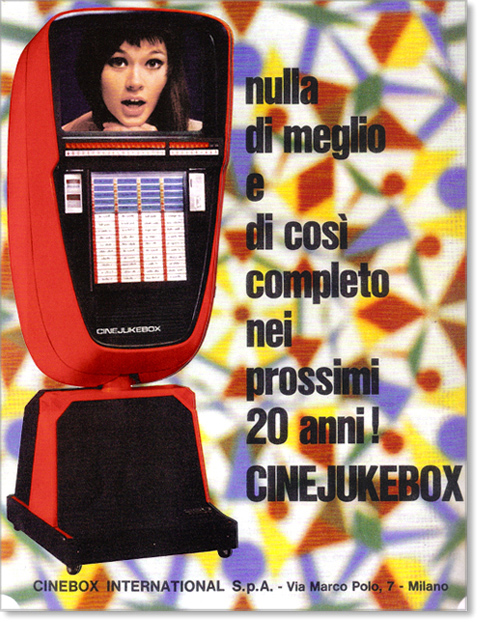
Cinejukebox model 50.

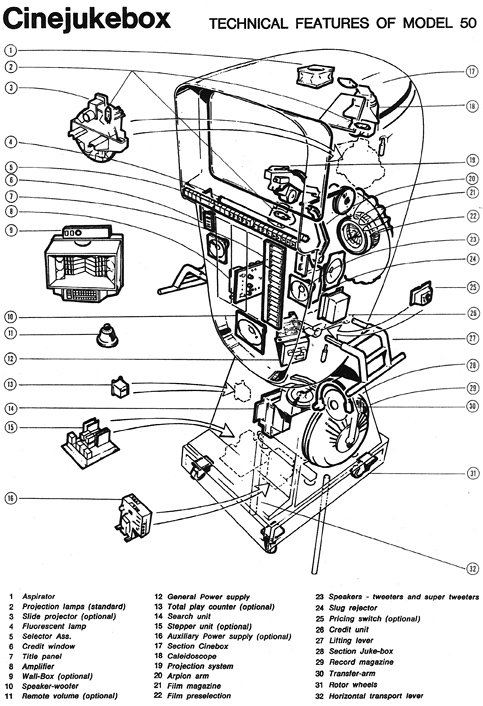
Technical features of Cinejukebox model 50.
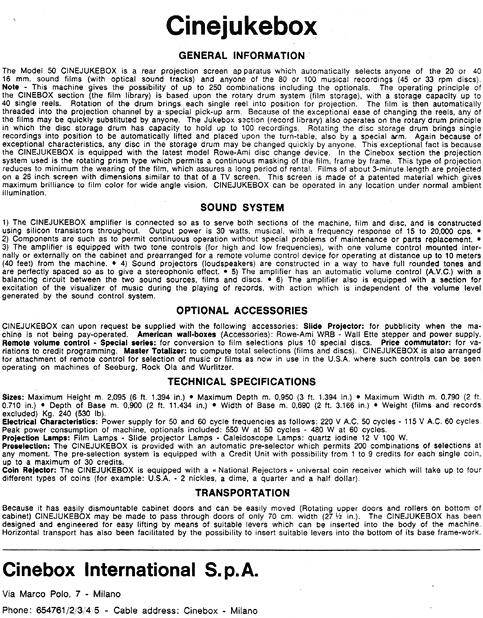
Technical features of Cinejukebox model 50.
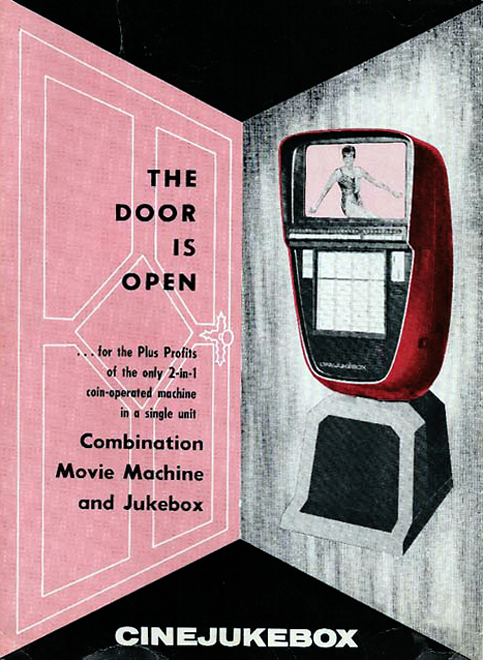
.

Here is the Cinejukebox, the last machine manufactured by SIF (Società Internazionale di Fonovisione – International Phonovision Society) for the American market.
Built in 1965, it was unveiled in October 1966 at the MOA (Music Operators of America) trade show in Chicago, under the slogan: “Nothing better or more complete will come along in the next 20 years!”
The production managers behind this new machine were Angelo Bottani and Giuseppe Lauro, Managing Director of Innocenti.
A masterpiece of Italian design, the Cinejukebox was manufactured by Innocenti on the production line left vacant by the Lambretta, whose patent had been sold to India. It contained 40 color 16mm films with an optical soundtrack and 200 songs selectable just like on a traditional jukebox.
The screen remained illuminated at all times: when no films were playing, the machine displayed pioneering abstract visual sequences known as “Color Dance”, in harmony with the music.
The ultra-stylish egg-shaped cabinet and video unit were designed and manufactured in Milan, while final assembly, together with the audio system supplied by the American company Rowe-Ami, took place in Philadelphia, at the facilities of David Rosen Corporation, a company specialising in the distribution of coin-operated machines (video games and jukeboxes) to casinos throughout California.
The films originally produced for the previous model – the Cinebox, first developed in 1959 at the laboratories of Ottico Meccanica Italiana in Rome and marketed by Milan-based SIF – featured Italian chart hits performed by some of the country’s most popular artists, from Mina to Gianni Morandi. They also included international pop stars such as Paul Anka, Neil Sedaka and Bobby Rydell, who even performed songs in Italian.
For the Cinejukebox, new films were added featuring British groups idolised by young audiences, such as the Beatles and Procol Harum, as well as American bands including the Monkees and the Young Rascals. However, this selection failed to capture the American market, which was the Cinejukebox’s primary target.
The industrial production plan, entrusted to engineer Sandro Colombo – who two years later would join Ferrari in Maranello – called for 5,000 units to be manufactured within one year.
Innocenti halted production after just 100 units, following a warning from its American partner Rosen that the machine was failing to generate the expected interest, largely due to the limited availability of films.
The 100 units manufactured by Innocenti were returned to a warehouse in Pennsylvania, where they remained unused until the autumn of 1983, when a fire at the North Broad Street premises in Philadelphia reduced them, along with everything else at the David Rosen facilities, to ashes.
Today, only one Cinejukebox is known to have survived anywhere in the world. It was purchased in the 1980s by Fausto Casi, an antiques dealer from Arezzo, and is now housed at the Museum of Communication Media in Arezzo, Italy.
By contrast, 25 examples of its predecessor, the Cinebox 61, have survived. Manufactured by Mival in Gardone Val Trompia, it featured a wooden cabinet crafted by San Giorgio in Alessandria, based on a design by Luigi Marzolla, the master artisan who also created the portals of Alessandria Cathedral.
Johnny Charlton, former guitarist of The Rokes, the most popular British group in Italy during the 1960s, introduces us to the Cinejukebox.
[Courtesy of Fausto Casi, director of The Museum of communication devices in Arezzo, Italy].

